
First published: 2 October 2026.
Score: 45 / 100
Verdict: Avoid
Last verified: 8 October 2026
How we score: How We Review
SodaTide is marketed as a once-daily synbiotic capsule for gut health, appetite control, metabolism and weight management. Some of the sales pages go considerably further, promising results like fat burning, managing blood sugar, appetite, and metabolic ‘rebalancing.’
It is sold as a vegetarian capsule combining prebiotic fibers with probiotic organisms. The label information reproduced on current SodaTide-related pages lists one capsule as the serving size, with 30 capsules per bottle:
- Probiotic blend (36 mg):
- Bifidobacterium infantis,
- Clostridium butyricum,
- Akkermansia muciniphila,
- Chicory root inulin (211 mg),
- Potato resistant starch (100 mg).
There is legitimate research behind some of its ingredients. And, this part is worth acknowledging.
The harder question is whether the research supports this particular product, at the amount of each ingredient disclosed on its label.
We found human studies of chicory inulin, resistant starch and Akkermansia muciniphila. We also found newer human research on a specific pasteurized A. muciniphila preparation. But those studies do not mean a clinical trial of SodaTide supplement.
The public record also has another problem: we found SodaTide-branded and marketplace pages describing formulations that do not consistently match the label reviewed here.
Independent customer reviews on different websites raise additional questions about billing and refunds. However, those reports are individual customer accounts and should not be treated as independently proven findings.
Therefore, SodaTide scores 45/100 under our SwasthyaAlly scoring system.
| Category | Score |
|---|---|
| Ingredient Evidence & Quality | 9 / 20 |
| Dosage & Formulation | 7 / 13 |
| Transparency & Testing | 6 / 12 |
| Safety & Suitability | 7 / 12 |
| Independent Customer Evidence | 2 / 10 |
| Buying, Shipping & Refunds | 5 / 9 |
| Value for Money | 4 / 8 |
| Marketing Honesty & Claims | 5 / 16 |
| Total | 45 / 100 |
Product Type: Metabolic booster
Exact Product Trial: No
Main Concern: Formula/dose uncertainty
Independent Reviews: Limited
Verdict: Avoid
Avoid means we would not buy SodaTide on the public record we could check. It does not mean the bottle is fake or illegal, and it is not a scam finding.
Who this review is for
This review is for readers who have encountered SodaTide through an online advertisement or sales page. It is for the men and women who want to match the product against the evidence.
This is especially important if you’re looking at SodaTide for weight loss, appetite control, gut health or prebiotic fiber.
This review is neither a diet plan or a treatment protocol. We are not telling readers to start or stop using this supplement.
1. Ingredient Evidence & Quality – 9 / 20
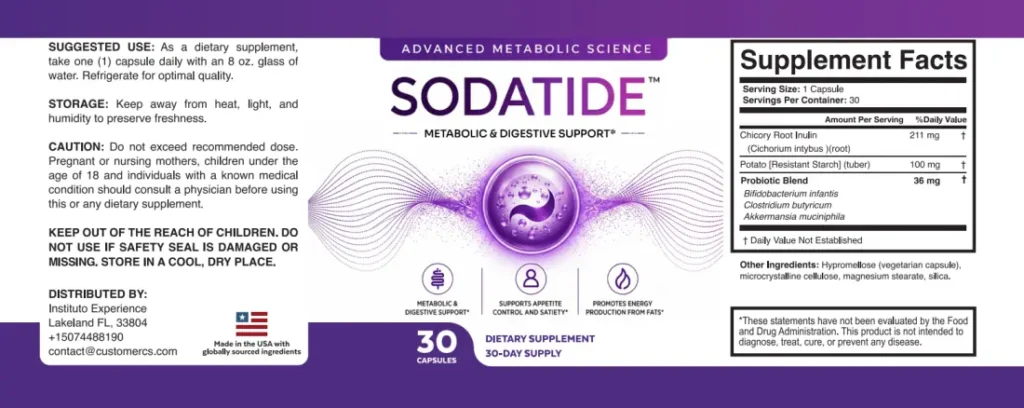
Supplement Facts label used for this review. Each capsule contains 211 mg of chicory root inulin, 100 mg of potato resistant starch, and 36 mg of probiotic blend. No CFU count.
The ingredients in the formula are not inherently unscientific. The problem is the distance between the research behind the ingredients and the final product being sold.
Chicory inulin
Randomized human trials have been studied for inulin from chicory. In 2024, a systematic review and meta-analysis included 32 randomized trials and found that chicory inulin-type fructans led to modest average reductions in body weight, BMI, fat mass and waist circumference compared with placebo. The average effect on body weight was approximately 0.97 kg.
That is useful evidence for chicory inulin-type fructans as a category.
But, it is not evidence that SodaTide causes the same result.
The dose is the first problem. The included trials used 3–30 g/day of chicory inulin-type fructans. The median dose was 10 g/day. SodaTide provides 211 mg (0.211 g) per capsule — substantially below the doses represented in this evidence base. A label amount of 211 mg cannot simply be treated as equivalent to gram-level research doses.
Potato resistant starch
Resistant starch has also been studied in humans for metabolic and gastrointestinal outcomes. Again, however, the relevant research generally uses amounts measured in grams.
A systematic review of randomized trials examining RS2 required studies to provide at least 8 g/day. SodaTide offers 100 mg (0.1 g), a far cry from that evidence base.
That doesn’t make the ingredient useless. It means that the label doesn’t provide the dose-to-study match necessary for making strong claims based on resistant starch research.
Akkermansia muciniphila
This is likely the most scientifically interesting ingredient in the formula.
About 10 billion A was given to overweight or obese insulin-resistant adults in a 2019 randomised, placebo-controlled pilot study. muciniphila bacteria to each person every day for three months. Pasteurised A. muciniphila improved some metabolic measures and was well tolerated, but the body weight result was not statistically significant, according to the study.
There is also newer evidence. A 2026 randomized trial involving 90 adults studied a specific pasteurized A. muciniphilapreparation, MucT, during weight-loss maintenance. The researchers reported less weight regain with MucT than placebo. Importantly, this was a specific preparation studied at a defined intervention, not SodaTide.
SodaTide’s published label information does not state the individual amount of A. muciniphila, does not provide a CFU count, and does not establish whether the bacteria is live or pasteurized.
That makes direct comparison with the clinical research impossible.
In our search of the publicly available literature, we found no clinical trial of the finished SodaTide product.
The ingredient evidence therefore earns some credit, but not enough to support the product’s broader marketing.
2. Dosage & Formulation – 7 / 13
SodaTide at least publishes milligram amounts for the two fibers and the combined probiotic blend. That is preferable to a completely undisclosed proprietary blend.
But the disclosure still has major limitations.
The 211 mg of inulin is a relatively small amount compared with the gram-level quantities used in human research. The 100 mg of resistant starch is also a fraction of the amounts commonly studied.
The 36 mg probiotic line creates a different problem. It names three organisms but does not disclose how much of each is present.
We would not assume the 36 mg is divided equally between the three organisms. We would not calculate a CFU number from milligrams. And we would not treat a product as equivalent to an A. muciniphila clinical trial simply because the species name appears on the label.
The conflicting formulation descriptions across SodaTide sites make this category weaker still.
3. Transparency & Testing – 6 / 12
We could verify several information from public pages, including the published ingredient amounts, product format and certain distributor/contact details.
What we could not verify was more consequential:
- a public certificate of analysis for the finished product;
- a named independent lab report;
- lot-specific probiotic potency;
- individual CFU counts;
- whether the A. muciniphila is live or pasteurized;
- a consistent formulation across all official-looking sales pages.
Some SodaTide pages describe the product as manufactured in an FDA-registered, GMP-certified facility. They also say batches are third-party tested. Those are company statements. We did not find a public testing report that allowed us to independently check the claimed testing.
The distinction around FDA language also matters. Registration of a facility is not the same thing as FDA approval.
We are not saying the product is contaminated or poorly manufactured. We simply could not verify the testing record from the public material available to us.
4. Safety & Suitability – 7 / 12
SodaTide ingredients have long histories of use by humans. But every formulation is not appropriate for every person.
Inulin and other fermentable fibres may cause gas, bloating and changes in bowel habits. Probiotics can also lead to temporary gastrointestinal symptoms.
If you are pregnant or nursing, have a medical condition, or are taking medications, you need to consult a qualified clinician before using a supplement.
Another information gap is the undisclosed probiotic cell counts. Without knowing the amount and the exact formulation it is harder to do a detailed assessment of both expected effects and possible tolerability.
Any reference to blood sugar, insulin sensitivity or metabolic pathways in the marketing of SodaTide should not be interpreted as SodaTide being a treatment for diabetes, obesity or any other medical condition.
5. Independent Customer Evidence – 2 / 10
This category needs a clear distinction between company testimonials and independent customer evidence.
SodaTide’s own pages feature positive testimonials and large claimed review numbers. Those are marketing materials controlled by the seller. They are not equivalent to an independently collected customer dataset.
One current sales page claims thousands of verified reviews, but we could not independently verify that number on a major third-party review platform.
The Trustpilot record is different.
The soda-tide.store profile on Trustpilot currently shows 18 reviews (+4 since this SodaTide review went live), a 1.8 TrustScore, 87% one-star reviews and no recent history of the company inviting reviews. Trustpilot itself says the lack of recent invitation history means the reviews may not be representative.
Some reviewers have cited extra charges, upselling, difficulty getting refunds or disagreement on refund amounts. These are comments from customers, not findings we confirmed.
One reviewer noted a 20% restocking fee; others reported receiving partial refunds. These are customer allegations and not independently verified findings of SwasthyaAlly.
Other reviewers say they have received the product and are happy with it. The sample is small, and customer reviews cannot establish whether SodaTide causes weight loss.
We also found other Trustpilot profiles associated with SodaTide-related domains, including sodatide-by.dr.lovable.app. These profiles had a very small number of reviews at the time of our check. So they do not provide a reliable basis for estimating overall customer satisfaction.
The useful conclusion is narrower: independent customer evidence is sparse and currently raises more questions about the purchasing experience.
6. Buying, Shipping & Refunds – 5 / 9
The official SodaTide sales pages currently show three main package options:
Pricing (do confirm at checkout):
- 2 bottles: about $158 total + $9.99 US shipping
- 3 bottles: about $207 ($69 each), free US shipping
- 6 bottles: about $294 ($49 each), free US shipping.
The seller advertises a 60-day money-back guarantee on their official site.
The problem is that the public refund information is not completely consistent.
The refund information is not completely consistent. There’s a 60-day money-back guarantee from the date of purchase on the official website. There’s a requirement that the buyer needs to use the product for at least 30 days. There’s a separate refund page too. As per wordings on that page, the 60-day refund period starts on the day the order is delivered. Customers need to email support team and follow the provided return instructions. These differences are worth noting.
Meanwhile, the Trustpilot page contains customer reports alleging restocking fees and partial-refund offers. Those reports should not be treated as proof that the published guarantee is universally being breached, but they are relevant because they conflict with the simple ‘money-back guarantee’ impression created by the sales copy.
As per FAQs on the sales page, the refund guarantee is unconditional and is applicable within 60 days from purchase. It requires at least 30 days of use. The buyer needs to email contact@customercs.com for guidance. The returns page at lp.institutoexperience.com.br says 60 days from the purchase date in the first paragraph, then Step 1 says 60 days from delivery. Those are not the same rule.
7. Value for Money – 4 / 8
At the advertised lowest package price, SodaTide costs $49 per bottle.
The question is not simply whether $49 is expensive. But, what the buyer receives for that price and how well it maps to the evidence.
The ingredient label lists 211 mg of inulin, 100 mg of resistant starch, and 36 mg of a probiotic blend with no CFU count. Therefore, it is difficult to compare the finished product with the research the marketing invokes.
The ingredients may have legitimate uses. But the product’s evidence-adjusted value is weakened by the dose uncertainty and lack of finished-product clinical evidence.
8. Marketing Honesty & Claims – 5 / 16
This is the most heavily weighted category for a reason.
SodaTide’s marketing sometimes moves from reasonable descriptions of microbiome research into much stronger claims about what the capsule itself will do.
The official sales page goes beyond general digestive-health language. It says the formula can ‘accelerate fat burning,’ ‘suppress appetite,’ ‘support lean muscle growth,’ ‘detoxify the body’ and ‘improve metabolism.’ It also describes the probiotic blend as transforming the gut into a ‘fat-burning machine.’
The underlying biology is real enough to study. But a biological pathway is not proof that this finished capsule produces the claimed clinical outcome.
The same issue appears with A. muciniphila. Human studies of specific preparations at specified doses are evidence about those interventions. They are not automatically evidence for a 36 mg proprietary blend with no disclosed cell count.
The sales funnel also uses urgency and promotional language, while customer-review claims are much larger than the independently verifiable review record we found.
That does not, by itself, establish fraud.
It does mean the marketing deserves a substantial deduction because the claims extend beyond what we could verify from the finished-product evidence.
Searches for ‘SodaTide reviews’ and ‘is SodaTide legit’ surface pages on USA Today and the Akron Beacon Journal. Both are paid press releases distributed by XPR Media. There’s clear mentioning on pages that news staff did not create the content. And the placement is a paid service.
A brand-protection review in October 2026 revealed 612 unauthorised listings. One unopened bottle from lot ST-260817-B passed a lab test for label match and contaminants (ISO/IEC 17025). We could not find a public certificate for that lot. Even if the milligrams match the label, that does not make 211 mg of inulin equivalent to the 3–30 g used in inulin trials, or 100 mg of resistant starch equivalent to studies that used at least 8 g.
The same release says SodaTide has not authorized celebrity endorsements. Separate customer complaints describe ads using Dr. Oz, Oprah, and other likenesses. We did not verify who bought those ads.
Final score: 45/100
9+7+6+7+2+5+4+5=45
FAQs
Is SodaTide legit?
We did not find proof the bottle is fake. Neither did we find proof that bottle is fake. We couldn’t find a clinical trial of SodaTide. The dose, the missing CFU count, the unverified testing claim, and the sales language are too weak. Therefore, we couldn’t treat it as a reasonable buy.
Did a lab prove it works?
A company press release says one lot matched its label. That is not a published trial and not proof of fat loss, appetite control, or better blood sugar.
Is the USA Today page a review?
No. It is a paid release. The byline is SodaTide media relations, not a USA Today reporter.
Verdict: Avoid
SodaTide is based on a plausible idea. Prebiotic fibers and selected probiotic organisms can influence the gut environment, and Akkermansia muciniphila is an active area of human research.
But the evidence needs to be attached to the intervention that was actually studied.
A study of gram-level inulin is not a study of 211 mg of inulin in SodaTide. A trial of a defined 10-billion-cell or otherwise specified A. muciniphila preparation is not equivalent to trial of a 36 mg blend that contains three named species with undisclosed CFU count.
At SwasthyaAlly, these differences count.
Until SodaTide has a consistent formula, meaningful probiotic potency information, publicly verifiable finished-product testing and clinical evidence on the actual product, the evidence is too incomplete for a higher score.
According to the SwasthyaAlly score, 45/100 falls in the Avoid band.
That ruling doesn’t mean SodaTide is fake, illegal or a proven scam.
It means we don’t have enough verified evidence of the product that justifies its marketing or the price.
Three issues matter most.
First, we found no clinical trial of the finished SodaTide product.
Second, the disclosed amounts do not provide a clear match to the doses used in the human research that the marketing relies on. And, the probiotic blend does not disclose individual amounts or CFU.
Third, the public buying record is less straightforward than the simple 60-day guarantee suggests, with inconsistent refund information. And, there’s a small independent review sample containing multiple complaints about billing and returns.
Who should avoid it
Extra caution is appropriate for:
- people considering SodaTide as a treatment for diabetes, obesity or another medical condition;
- people taking medication, particularly where a clinician should review supplement use;
- pregnant or breastfeeding women;
- people who are immunocompromised;
- anyone who would have difficulty absorbing a large unexpected charge while resolving a refund;
- anyone who has not read the actual Supplement Facts information before ordering.
What we know & what we don’t
Reasonably established: The real prebiotic ingredients are chicory inulin and resistant starch. Akkermansia muciniphila has also been studied in humans.
Company-reported: SodaTide’s manufacturing claims, testing claims, customer-review totals, product benefits, and money-back guarantee.
Publicly reported label information:
- 211 mg chicory root inulin,
- 100 mg potato resistant starch,
- a 36 mg three-organism probiotic blend.
Unverified:
- individual probiotic amounts,
- CFU count,
- live vs pasteurised A. muciniphila,
- publicly available finished product certificate of analysis,
- why different SodaTide pages describe different formulations.
Not studied: SodaTide as the exact finished product.
Disclosure
SwasthyaAlly is an educational website. It doesn’t provide medical, nutrition, legal, or financial advice. Some links may be affiliate links. See our Disclaimer and Affiliate Disclosure for full details.
Pingback: Autoship, 'Free Bottle,' and Refund Fine Print: How the Checkout Becomes the Product