
First published: 6 October 2026.
Score: 42/100
Verdict: Avoid
Last verified: 6 October 2026
How we score: How We Review
Akemi Coffee Boost is a powdered drink food supplement that comes in a single-use sachet. Their sales page asks users to stir one sachet of this morning coffee supplement into coffee, tea, water, or a smoothie. Seven ingredients have been named on the official site:
- green tea extract,
- green coffee bean extract,
- white kidney bean extract,
- mulberry leaf extract,
- L-carnitine,
- L-tartrate,
- Resistant dextrin,
- Psyllium husk powder.
Each sachet contains approximately 30 mg of caffeine in the form of green coffee bean extract.
The marketing goes further. The hero line is ‘Fight Fat with Your Morning Coffee.’ Under that: ‘Blocks carbs, stabilizes blood sugar & kills cravings, without changing a single habit.’
A before-and-after picture on the same screen is labeled 205 lbs and 167 lbs. The page also shows 4.8/5 from 3,758 reviews, a ‘limited time’ 70% off banner, and a named clinician quote.
We checked the order page, the checkout screen on 6 October 2026, the ingredient claims, shipping and refund copy, and the promotional links traveling with the product. However, we did not find a randomized trial of this blend.
While some of these ingredients have a real research story, it is not the same as proving this sachet works. Yes, ingredient research is not product research.
This review is educational. It is neither a weight-loss nor a blood-sugar management plan.
| Category | Score |
|---|---|
| Ingredient Evidence & Quality | 11 / 20 |
| Dosage & Formulation | 5 / 13 |
| Transparency & Testing | 4 / 12 |
| Safety & Suitability | 6 / 12 |
| Independent Customer Evidence | 2 / 10 |
| Buying, Shipping & Refunds | 6 / 9 |
| Value for Money | 4 / 8 |
| Marketing Honesty & Claims | 4 / 16 |
| Total | 42 / 100 |
Product Type: Boosts Metabolism
Exact Product Trial: No
Main Concern: Some ingredients have relevant research, but dose uncertainty
Independent Reviews: Limited evidence outside the company’s own website.
Verdict: Avoid
Avoid means we would not buy it on the public record we could check. It does not mean the sachet is fake or illegal.
Who this review is for
This review is for anyone looking at Akemi Coffee Boost for weight loss, cravings control, blood sugar management, or ‘metabolism boost,’ especially after a before-and-after ad.
It is not a review of ordinary coffee. The question is whether the label, the doses, and the buying terms support the way the page sells it.
1. Ingredient Evidence & Quality – 11 / 20
The ingredient list is not nonsense. That is the fair part.
Green tea catechins plus caffeine are backed with human trials. The average weight effect is small. But, concentrated green tea extract is also mentioned in a study with a published liver-injury signal. Brewed tea is not the same thing. The U.S. National Center for Complementary and Integrative Health has summarized that difference on its green tea page.
Green coffee bean extract is added in the formula for its chlorogenic acids. Older reviews found modest BMI differences in small, uneven trials. Those papers are not a test of Akemi Coffee Boost. About 30 mg of caffeine from the extract is a small add-on next to a normal cup of coffee.
White kidney bean extract has the clearest recent study. A 2026 systematic review in ‘Nutrition Research’ pooled eight randomized trials. And, it included 543 overweight adults. Average weight loss versus control was about 1.6 kg. Fasting glucose did not move in a clear way. That is a real finding. It is also not ‘Block Carbs.’ The paper is here: Nutrition Research, 2026.
Mulberry leaf has post-meal glucose studies at defined leaf or DNJ amounts. L-carnitine’s weight loss history is modest and mostly at gram doses.
Resistant dextrin and psyllium are fibers. Fullness shows up when the grams are real.
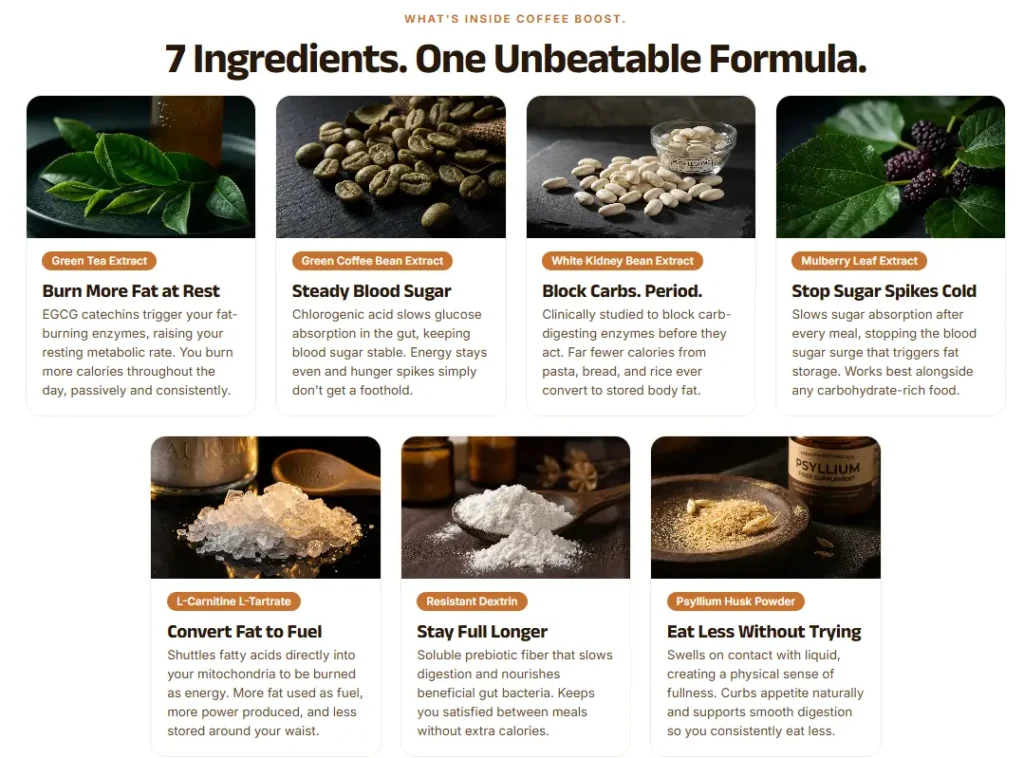
Akemi Coffee Boost does not publish those grams on the order page. Without them, a study dose cannot be matched to this stick. No trial of the seven-ingredient blend showed up in the pages we checked. That is why a real ingredient profile still scores 11.
2. Dosage & Formulation – 5 / 13
Using Akemi Coffee Boost is simple. One sachet a day. The checkout page we saw sells 20, 40, or 60 sachets. Therefore, one box is about 20 days.
The caffeine line is useful. About 30 mg, from green coffee bean extract, on top of whatever is already in the cup.
However, the dose line is not. The order page names seven ingredients and does not give an exact milligram dosage for any of them. The product images we were given name the seven and still do not split them.
Carton and brand pages put the box at 40 g net for 20 sachets. That is 2 grams per stick.
Two grams is the whole serving. Psyllium studies for fullness often use several grams of husk alone. Resistant-dextrin studies often use several grams. L-carnitine studies often use 1–2 grams. Those numbers cannot all be true inside one 2 g stick that also holds four extracts.
So the formula can list seven names and still be under-dosed for the claims. Naming is not dosing. We explain that trap on How to Read a Supplement Facts Panel.
Day-5 cravings and day-21 ‘measurable changes’ cannot be checked without those amounts, and without a trial of the finished product.
3. Transparency & Testing – 4 / 12
What is public:
- the seven ingredient names,
- about 30 mg caffeine per sachet,
- 20 sachets per box,
- email: support@buyakemicoffeeboost.com,
- and phone: +1 (888) 907-2458.
A sponsored USA Today press release dated 17 September 2026 lists 841 Fairmount Ave, Elizabeth, NJ 07201 as the address, and a media contact. The page says editorial staff were not involved and that placement is a paid service. It also says ingredient presence does not establish a result for the finished product.
What we could not find:
- a Supplement Facts label,
- extract standardization,
- a certificate of analysis,
- or the name of the lab behind ‘Third-Party Tested.’
- ‘GMP-Certified Facility’ is a badge on the page. A badge is not a certificate.
The page says Akemi Coffee Boost is formulated by a clinician. It quotes Dr. James Collins, who is described as an MD and board-certified nutritionist. We did not find reference to a clinic, license, or study under that quote. A quote on a sales page is marketing until it is traceable.
‘JavaBurn™’ is used for the blood-sugar management blend. But, Java Burn is already the name of a different coffee-sachet product. Using it here is kind-of confusing. It does not tell you what exactly is in the stick.
We did not see an ‘FDA approved’ claim on the order page. Dietary supplements are not FDA-approved for safety and effectiveness before sale. Facility registration, if a page claims it, is not product approval. FDA’s own consumer page makes that split.
4. Safety & Suitability – 6 / 12
The sales page says ‘Zero Side Effects.’ Well, that is not a safety review.
About 30 mg of caffeine is the clearest number. It stacks on the drink. A sachet in a mug of coffee is not a 30 mg day.
Green tea extract is the published caution. Liver-injury reports cluster around concentrated extracts, not a cup of tea. NCCIH’s green tea page is the plain source. People with liver disease should not treat this as a casual add-in.
Psyllium swells. That is the sales pitch. It is why fiber is often taken with water. This can change the timing of other medicines. The missing dosage of each ingredient makes that risk hard to size.
Some Akemi Coffee Boost pages suggest pregnant women, people on medication, and people with a serious condition to ask a clinician first. However, it is not a product-specific safety protocol.
We are not saying the sachet is unsafe. We are saying seven names, one caffeine number, and a ‘zero side effects’ line are not enough for a high score. This is not a blood-sugar treatment. Therefore, we suggest avoiding adding it to diabetes medication just because an ad said it stabilizes glucose.
5. Independent Customer Evidence – 2 / 10
The official website says 4.8/5 from 3,758 reviews. Those stars sit on the page that is selling the product. We treat them as marketing.
Outside, the record is thin and messy.
Trustpilot’s profile is for akemi-coffee-boost.lovable.app, not buyakemicoffeeboost.com. When we checked on 6 October 2026, it showed 8 reviews and a 2.3 TrustScore. Trustpilot says the company has not recently invited reviews, so the set may not represent buyers.
Reviewers reported no email reply, a brown taste instead of ‘flavorless,’ extra items on an order, and a price shown in dollars that resolved as a USD charge. Some called it a scam. Those are customer reports, not our finding.
That lovable.app page also lists a different ingredient formulation: chromium, Ceylon cinnamon, roasted arabica, and soluble fiber. Same brand name. Different formula. Reviews on that domain are not evidence for this box.
The USA Today URL is a paid placement, not a test. Other ‘Akemi Coffee Boost review’ pages in the same cluster read as advertorials.
A Reddit thread titled as an Australia review sits in r/PokemonCardsDeals. We do not count that as independent take.
Useful conclusion: independent customer evidence is sparse, and the loud number never leaves the sales page.
6. Buying, Shipping & Refunds – 6 / 9
Checkout page checked 6 October 2026, U.S. funnel:
- 1 box, 20 sachets: $29.9; Original price: $66.64
- 2 boxes, 40 sachets: $49.98 ($24.99 a box)
- 3 boxes, 60 sachets: $59.97($19.99 a box)
Brand pages (for Canadian or Australian traffic) have also listed about $33.32, $55.53, and $66.63 for the same three tiers.
The screen we saw said ‘This is a one-time purchase only’ and no recurring billing. That is better than many coffee-sachet funnels. Funnels change. Therefore, recheck the box before you pay.
Shipping copy does not match. One answer says processing within 48 business hours and 8–10 days from the order date. Another says 1–2 business days to ship and 5–10 business days in transit. Tracking is promised by email.
The refund line on the FAQ is one sentence: return the product, refund within 30 days. But, there’s no return address on that FAQ. No rule for opened sachets. No line on who pays postage.
Secondary writeups say the Terms of Service reserve a minimum 15% restocking fee and that return shipping is on the buyer. We are not confirming this yet as we did not open a live terms page that showed that clause. Read the terms before you pay. Keep the checkout screenshot. A 30-day banner that is thinner than the terms is only half a policy.
‘Only 247 boxes left’ next to three bundle sizes is scarcity theater, not a warehouse report. That pattern is on Six Wellness-Ad Patterns That Are Not Proof.
7. Value for Money – 4 / 8
At the 6 October promo, one sachet is about $1.50 on a single box and about $1.00 on the three-box bundle. At the $33.32 list price, it is about $1.67. Against a coffee habit, that can look cheap. Against the label, it is not.
You are not shown the dose. If the carton is 40 g for 20 sticks, you are buying 2 grams of unnamed splits. A plain psyllium tub prints the grams. This funnel does not.
The crossed-out $66.64 is the anchor for the ‘70% off’ math. We did not find a stable everyday price at $66.64 outside the funnel. A discount off a tall anchor is not the same as value.
8. Marketing Honesty & Claims – 4 / 16
This is the weakest category.
Narrowly fair:
- it is a drink blend,
- caffeine is stated as about 30 mg,
- the checkout we saw said one-time billing,
- and ‘flavorless’ is a claim buyers can test.
The rest runs ahead of the evidence.
– ‘Blocks carbs, stabilizes blood sugar & kills cravings, without changing a single habit.’
– ‘Burn More Fat at Rest.’ ‘Block Carbs.’ ‘Stop Sugar Spikes.’
– ‘No Lifestyle Change Needed,’ next to a 205 lb to 167 lb photo.
– ‘4.8/5 based on 3,758 reviews,’ with no database we could open.
– ‘As Seen On’ logos for ABC, USA Today, Fox News, Today, and NBC. The USA Today hit we found is a paid placement. A logo is not a segment.
– ‘Clinically studied’ under white kidney bean. A reader can take it as ‘this product was studied.’ It was not, on the record we checked.
– ‘Zero Side Effects.’
A low score is not a scam finding. A real powder can still have a loud page. We use ‘scam’ for a documented pattern, such as a fake checkout or a product that does not exist. We did not need that word to score the claims.
Final score: 42/100
11+5+4+6+2+6+4+4=42
FAQs
Is Akemi Coffee Boost a scam?
It is not a scam. We did not see a fake payment page or a product that does not exist. The checkout we saw said one-time billing. What we did find is weak product evidence, missing doses, paid ‘as seen on’ placement, a review domain with a different formula, and customer complaints about email silence. That is a thin label and loud marketing.Customers on Trustpilot used the word. We did not.
What is the dose?
The sales page doesn’t say. Akemi Coffee Boost contains 7 ingredients and around 30 mg of caffeine from green coffee bean extract. Carton and brand pages list 40 g net for 20 sachets, i.e. 2 g per stick. And we won’t know what the split inside those 2 grams will be until a Supplement Facts label is published.
How much caffeine does it contain?
Each sachet is filled with approximately 30 mg of green coffee bean extract. And that’s on top of the coffee, tea or other beverage you stir it into.
Does the 30-day refund look complete?
It is advertised. It is not explained on the FAQ. ‘Simply return your product’ does not name the address, the window after delivery, opened sachets, or return postage. Other writeups say the terms reserve a 15% restocking fee.
Will Akemi Coffee Boost block carbs or kill cravings?
The page says yes. The record we checked does not. White kidney bean extract has trials, with an average loss near 1.6 kg in one 2026 review, not a carb block in this sachet. Those trials are not Akemi, and a 2 g stick is a poor match for the fiber and carnitine doses used in research.
Verdict: Avoid
Avoid simply means we would not buy it on the record we checked. This doesn’t mean the sachet is either counterfeit or every named ingredient is useless.
The reasons are ordinary and enough. No trial of the blend. No individual doses on the order page. A 2 g stick that cannot hold the studied amounts for the fibers and carnitine at the same time. Customer proof that does not leave the sales page. A before-and-after that says no habit has to change.
Believe the quieter line in the paid placement: ingredient presence is not a clinical result for the finished product.
Who should avoid it
- Anyone who wants a tested weight-loss treatment. This is not one.
- Pregnant or breastfeeding women. The page does not make a clear case for them.
- People with liver disease, or people told to avoid green tea extract.
- People on diabetes medication, or anyone using this to ‘stabilize blood sugar’ instead of care.
- People who need to separate medicines from fiber.
- Anyone buying because of the 205-to-167 photo.
Better first steps
These are not a protocol. They are the checks the ad skips.
1. If you do have a problem with excess weight or blood sugar, you need to talk to a clinician.
2. If you want fiber only, buy a product that lists the grams of psyllium or dextrin on a Supplement Facts label.
3. Combine caffeine from the cup and the sachet together. About 30 mg on top of coffee is not ‘no stimulant.’
4. If you already ordered, keep the checkout screenshot. You’ll have to ask the support team for the return address, who’s paying for postage, and whether there’s a restocking fee.
Disclosure
SwasthyaAlly is an educational website. It doesn’t provide medical, nutrition, legal, or financial advice. Some links may be affiliate links. See our Disclaimer and Affiliate Disclosure for full details.
Pingback: Doctor Recommended does not mean What You Think: 6 Checks